Avatar Frontiers of Pandora and Cyberpunk 2077 Share a Common Immersion-Breaking Flaw
Avatar: Frontiers of Pandora and Cyberpunk 2077 share a critical design limitation in their first-person perspective, which intriguingly impacts player immersion and connection despite their vastly different settings.
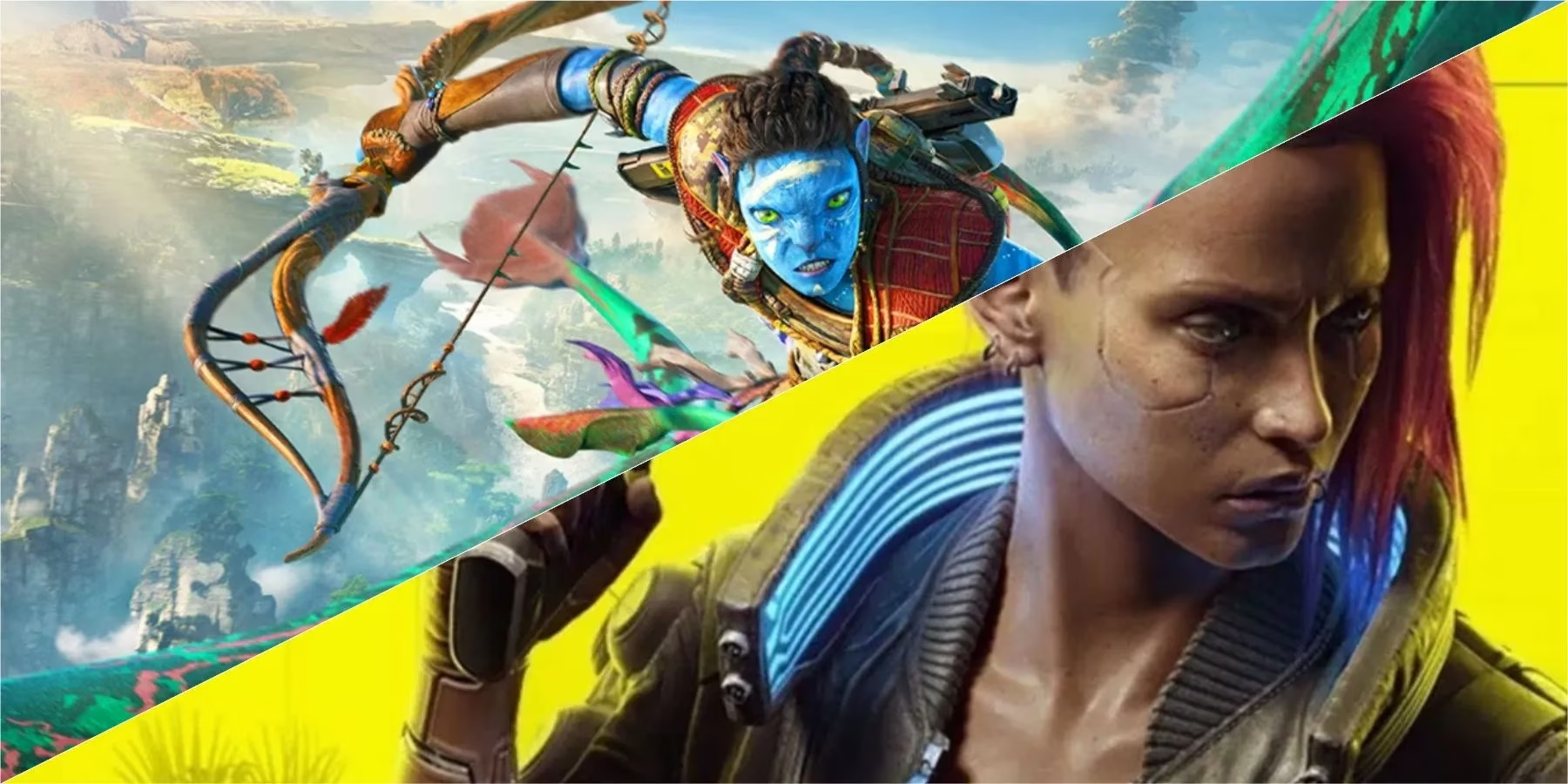
When diving into the lush, alien world of Avatar: Frontiers of Pandora in 2026, players might experience a strange sense of déjà vu, but not necessarily from the bioluminescent flora or the towering Hometree. Instead, a peculiar and persistent design choice echoes a critique once heavily levied against another genre titan: Cyberpunk 2077. Both games, despite occupying wildly different corners of the gaming universe, are fundamentally first-person experiences that lock players out of a feature many consider essential for immersion and connection—a consistent, freely accessible third-person perspective. This shared limitation creates a fascinating point of comparison between a futuristic dystopian RPG and a mystical alien adventure, highlighting how a single design decision can impact player engagement across disparate settings.
🔍 The Core of the Contradiction: Creation vs. Concealment
At their heart, both Avatar: Frontiers of Pandora and Cyberpunk 2077 are built on a foundational promise of player agency and identity. This promise begins right at the start screen with their character creation suites. Cyberpunk 2077 launched with an incredibly granular and detailed character creator, allowing players to sculpt every nuance of their mercenary, V. Similarly, Avatar: Frontiers of Pandora provides players with tools to craft their own unique Na'vi, choosing facial features, body markings, and other aesthetic details. The games then double down on this by placing a massive emphasis on gear acquisition and cosmetic progression. Finding a new, sleek set of corporate armor in Night City or crafting a vibrant, plant-woven chestpiece in Pandora is a core gameplay loop. 🎮
Herein lies the core contradiction: both games dedicate significant resources to letting players build and customize a visual identity, yet their primary gameplay perspective actively hides that identity from the player. The vast majority of gameplay in both titles is experienced through a first-person viewpoint. Your meticulously crafted visage, your hard-earned gear that changes your silhouette—it all exists primarily in menus and fleeting reflections. You are constantly told you look a certain way through stats and menu icons, but you are rarely shown. This creates a disconnect between the player's investment in their character's appearance and their in-game experience.
👁️ The Glimpses and the Missed Opportunities
Neither game is completely devoid of third-person moments, but these instances often feel like teases rather than solutions.
-
Cyberpunk 2077's primary method of self-viewing is through mirrors scattered in safehouses and some quest locations. Riding vehicles also offers a distant third-person view. However, seeking out a mirror is a deliberate, often out-of-the-way action, and the vehicle camera is usually too zoomed-out to appreciate detail.
-
Avatar: Frontiers of Pandora slightly improves on this model. Players get a third-person perspective while riding their Ikran mounts, which is a more integral part of exploration. However, the camera is often positioned behind and above the mount, making it tricky to get a clear, frontal look at your Na'vi's new gear or tattoos. The game also features cinematic moments in cutscenes, but these are scripted and not player-controlled.
The irony is palpable. In Cyberpunk, you can spend hours customizing your car's paint job and see it constantly, but your own character remains a pair of floating hands. In Avatar, you can meticulously customize your Ikran's saddle, skin patterns, and headgear—all visible during flight—while your own character's new ceremonial garb remains largely out of sight. 🦅
🧠 The Psychology of the Problem: Why It Matters
This isn't just a minor nitpick about camera angles. It's a matter of player investment and identity projection. RPGs and action-adventure games thrive on making the player feel connected to their avatar. When you can see your character reacting to the world, wearing the gear you fought for, it reinforces your role in the narrative. It's a form of visual feedback and reward. Hiding the character breaks that feedback loop. The desire to see one's creation is a powerful driver in games with customization; it's why photo modes are so wildly popular. Players want to be their character, but they also want to see who they are in that world.
⚖️ The Trade-Off: Immersion vs. Exhibition
The likely reason for this persistent first-person design is immersion. Both developers, Ubisoft Massive and CD Projekt Red, arguably prioritized placing the player directly into the eyes of the protagonist. The first-person view in Cyberpunk amplifies the intensity of Night City's chaos, while in Avatar, it makes the scale of Pandora's flora and fauna feel more overwhelming and real. This is a valid and effective design choice for fostering a sense of presence.
However, the trade-off is a diminished connection to the character as a visual entity. It creates a scenario where the game's systems (customization, loot) are at odds with its presentation. Other successful RPGs like the Elder Scrolls or Fallout series have long offered a toggle between first and third-person, acknowledging that different players have different preferences for how they connect with their character.
💎 The Verdict: A Lingering Design Quirk
As of 2026, this remains a shared, quirky footnote in the legacies of both games. Cyberpunk 2077, despite its monumental post-launch recovery and updates, never added a true third-person mode, cementing it as a core, unshakable part of its identity. Avatar: Frontiers of Pandora followed a similar path, opting for the immersive but limiting first-person vantage point as its default.
For players, the lesson is clear: when booting up a game with deep customization, it's worth checking the perspective. Do you want to inhabit the character completely, even if it means seldom seeing them? Or do you prefer to direct them as a visible agent in the world? This shared "flaw" between the neon-soaked streets of Night City and the vibrant jungles of Pandora shows that even in the most advanced open worlds, the simplest choices—like where to put the camera—can define the player's relationship with their digital self. Ultimately, both games deliver incredible worlds to explore, but they ask players to admire their reflection only in passing glances. ✨
Based on evaluations from OpenCritic, it’s clear that perspective decisions can heavily influence how players judge immersion and role-play payoff—especially in customization-heavy first-person games. In the context of Avatar: Frontiers of Pandora and Cyberpunk 2077, the absence of a freely toggled third-person camera can make cosmetic progression feel less rewarding moment-to-moment, because much of the “identity” work players do is only visible in menus, scripted scenes, or brief viewing windows rather than during core exploration and combat.