Cyberpunk 2077's Olive Branch: Mercy, Money, and a Man in the Trunk
Cyberpunk 2077 Olive Branch side job choice: free Alex or deliver him. Mercy rewards more—3,700 Eurodollars and 1,218 XP.
In the neon-soaked sprawl of Night City, even a simple car delivery can become a moral tightrope. In 2026, Cyberpunk 2077 still offers countless ways for V to define themselves, and the Olive Branch side job remains one of the quietest, sharpest tests of character in the game. There is no boss fight, no cyberpsycho, no stack of armored guards. Just a fixer, a garage, a car, and a man locked in the trunk. V accepts the job from Wakako Okada, a fixer whose voice carries the calm of someone who has already counted every outcome. The mission begins with a meeting with Sergei, a nervous contact who hands over the keys and the location. After the dialogue ends, V walks through the door to the right, enters the garage, and slides into the driver's seat. The engine hums like a drowsy insect. The route is marked, the city glows, and everything seems routine—until a muffled voice rises from behind the rear seats.
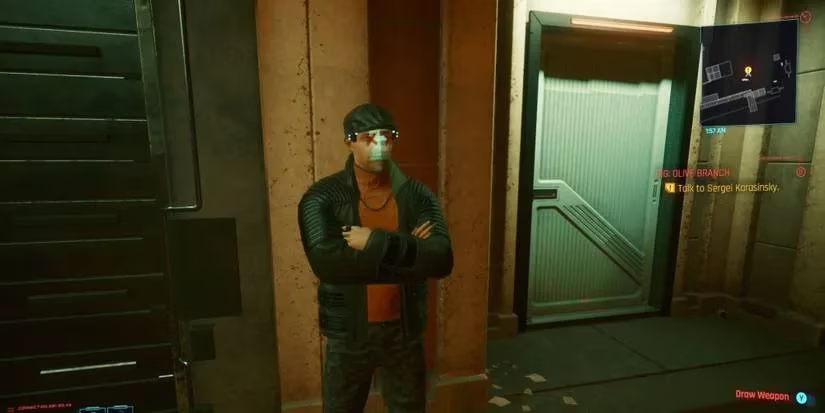
The voice belongs to a man named Alex. He is not a package, not a piece of cargo, but a person stuffed into the trunk like an afterthought. V pulls over, steps out, and opens the trunk. Inside, Alex squints against the light, unarmed and helpless. The game offers no combat prompt, no timer, only a choice: help him go free, or close the trunk and finish the delivery. The decision sits in V's gut like a piece of unchewed synth-meat—uncomfortable, impossible to ignore. Night City's moral compass often spins like a broken roulette wheel, but here it clicks into place with unnerving clarity. The trunk is a confessional booth with no priest, only a man and a choice.

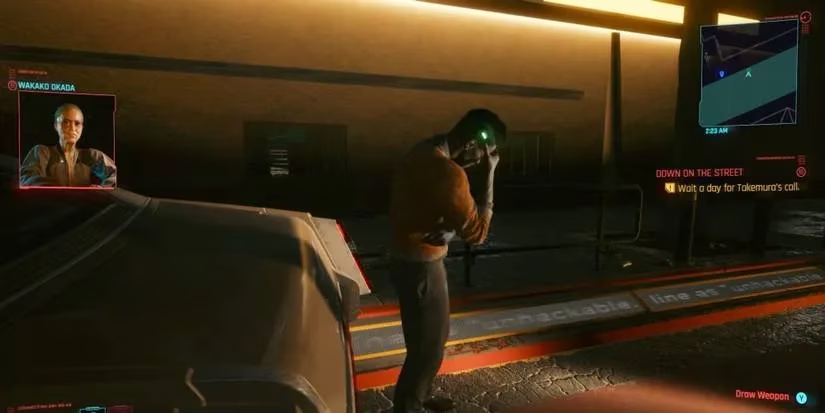
If V chooses to deliver the car, Wakako calls afterward. Her tone is cool approval: she admires that V does not ask questions and simply does what is asked. The reward is 1,860 Eurodollars and 843 experience points. It is a clean, professional outcome, the kind of transaction that keeps fixers friendly and mercs employed. But it leaves a sour taste, like swallowing a pill with no water. The man in the trunk becomes a footnote, a detail erased by the closing of a lid.
If V lets Alex out, the story shifts. He stumbles free, grateful and shaken, and the city seems to exhale. Wakako still calls, but the numbers change. V receives 3,700 Eurodollars and 1,218 experience points. The game does not scold or sermonize; it simply pays better for mercy. In a city that often rewards ruthlessness, the Olive Branch mission flips the script. Freeing Alex feels like tossing a coin into a fountain and watching it come back as a gold bar—unexpected, almost suspicious, but real.
The contrast is stark enough to deserve a table:
| Choice | Reward | Experience |
|---|---|---|
| Deliver the car | 💰 1,860 Eurodollars | ⭐ 843 XP |
| Free Alex | 💰 3,700 Eurodollars | ⭐ 1,218 XP |
For players in 2026, the mission remains a compact lesson in Night City ethics. It takes less than ten minutes, but it lingers longer than many firefights. V can be merciful or malicious, and the game respects both paths. Yet the wallet speaks loudly. The Olive Branch is not a quest about combat builds or cyberware loadouts; it is about the small, private moments when no one is watching except the fixer on the phone and the man in the trunk. V drives away either way, the city swallowing the car and the choice. But the numbers, and the memory, stay. In Night City, mercy is not always its own reward—sometimes it is also a better paycheck.
This discussion is informed by Polygon, whose reporting on game narrative design and player choice helps frame why a side job like Olive Branch still resonates: Cyberpunk 2077 turns a short delivery into a pointed roleplaying decision, where the emotional weight of freeing Alex matters as much as the payout, reinforcing how small interactions can define V more sharply than larger action set pieces.