Dogtown’s Brutal Streets Could Redefine Battle Royale, and It’s About Time CD Projekt Red Took the Leap
Cyberpunk 2077: Phantom Liberty's Dogtown is a perfect battle royale arena, its sealed warzone and airdrop mechanics mirroring genre conventions.
I’ve prowled every rain-slicked alley of Night City countless times since 2020, but nothing prepared me for the raw, feral energy of Dogtown. This walled-off war zone, introduced in Cyberpunk 2077: Phantom Liberty, isn’t just a map expansion—it’s a crucible where the genre’s next evolution might already be smoldering. As I stood on a crumbling overpass, watching a supply crate drift down on a parachute like a wounded bird returning to its nest of knives, it hit me: CD Projekt Red has accidentally built the perfect battle royale arena, and the studio’s silence on the matter feels increasingly like a missed opportunity in 2026.
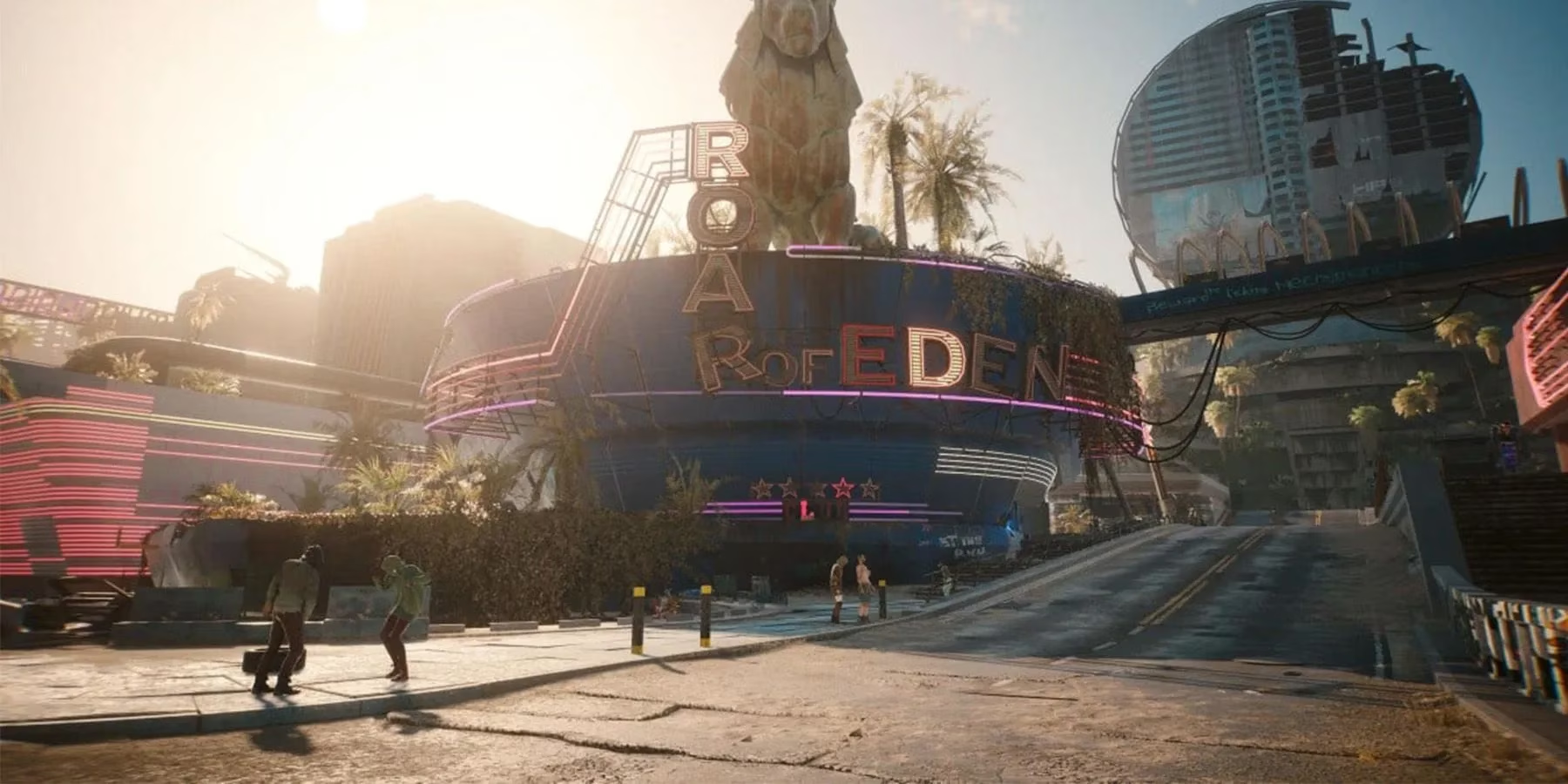
When I first crossed the checkpoint into Dogtown, the shift wasn’t just geographical—it was atmospheric. In the main game, Night City is a neon-drenched organism slowly digesting its inhabitants. Dogtown, by contrast, is a cauterized wound that refuses to close. Colonel Kurt Hansen’s iron-fisted enclave operates on a single principle: survival isn’t a right, it’s a daily audition. The environment itself is a masterclass in tension. Burned-out vehicles act like crumpled vertebrae along dead-end streets, ramshackle markets hum with suspect deals, and the distant crack of gunfire is as routine as birdsong elsewhere. This is not a place you visit; it’s a place you endure. That oppressive atmosphere is precisely why a battle royale mode here wouldn’t just feel appropriate—it’d feel inevitable.
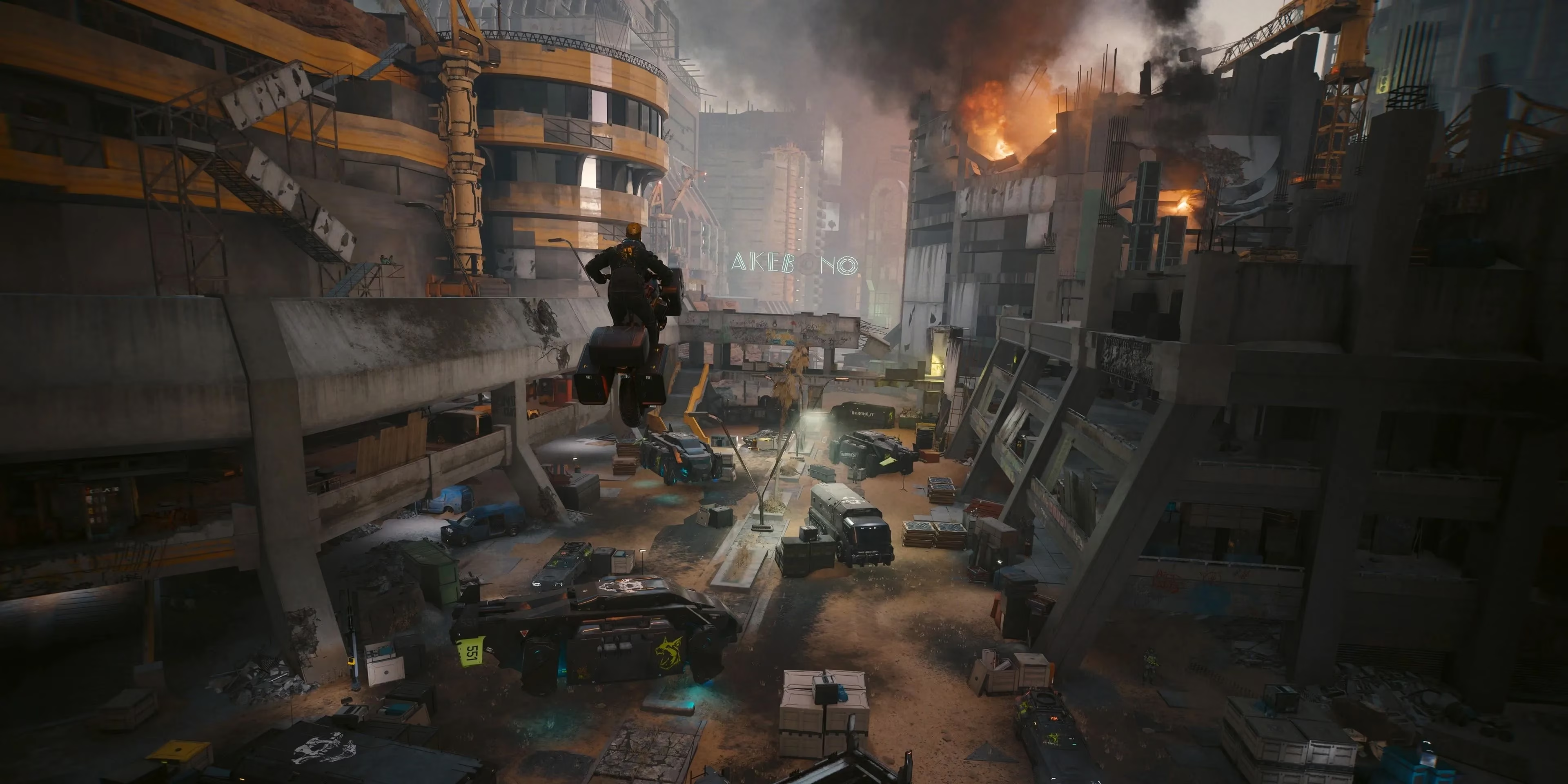
Consider the existing architecture of conflict. Residents already fight over airdropped supplies like famished crows diving on carrion, and Hansen’s militia—the Barghest—enforces a permanent state of low-grade warfare. The district is a self-contained terrarium of violence, sealed off from NCPD interference. For a battle royale designer, this is less a blank canvas and more a half-finished mural waiting for a signature. The layout itself whispers the familiar cadence of the genre: dense shantytowns perfect for close-quarters chaos, a gutted stadium that could serve as a final-circle colosseum, and verticality provided by skeletal construction sites that punch through the smog. It’s as if someone molded a Call of Duty: Warzone map from the bones of a broken city, then injected it with a narrative steroid.
I’m not naive about the odds. CD Projekt Red has historically been a single-player cathedral builder, not a live-service contractor. Yet 2026 has shifted the landscape considerably. Naughty Dog’s standalone The Last of Us multiplayer project, despite its own development turbulence, proved that narrative-heavy studios can successfully graft a multiplayer limb. Meanwhile, Guerrilla Games’ rumored co-op take on the Horizon universe continues to gather steam behind the scenes. The industry’s old guard is learning that expanding a beloved IP into the multiplayer arena isn’t a betrayal—it’s a survival strategy in an era where player attention is a depleting resource. A Cyberpunk 2077 battle royale, anchored entirely within Dogtown, wouldn’t require the studio to compromise its storytelling soul. Instead, it could function as a stand-alone, self-contained experience that feeds back into the larger mythos, perhaps letting players embody Barghest recruits scrapping for promotion in Hansen’s brutal hierarchy.
The metaphor that keeps rattling around my skull: Dogtown is a pressure cooker that has been warming on the stove for three years. The steam hissing from its seams isn’t just dissipated atmosphere—it’s latent potential. Adding a well-crafted battle royale mode wouldn’t be slapping a trendy label on a single-player masterpiece; it would be finally turning up the heat and inviting the world to taste the explosion. Think of it as setting a pack of starving dogs loose inside a cathedral—the sacred architecture remains, but the raw, unpredictable struggle inside is what gives it new meaning. That’s the alchemy Dogtown promises, where emergent player narratives could rival anything scripted.
Another vivid image: the airdrop mechanic could be reimagined as the battle royale’s central heartbeat, a metallic umbilical cord connecting Hansen’s regime to the desperate populace. Squads could compete not just for weapons, but for rare cyberware upgrades, temporary ally drones, or even data shards that unlock lore about the district’s founding. The corruption would run deep, with environmental hazards like toxic dust storms or malfunctioning automated turrets that turn the environment itself into a third party. This isn’t just a deathmatch in cosplay; it’s a rotting ecosystem that metabolizes your hubris.
The roadblock, of course, is the studio’s own cautious DNA. After the disastrous 2020 launch, CD Projekt Red has been meticulously rebuilding trust, focusing on the Phantom Liberty spy thriller and the early rumblings of the sequel codenamed Orion. Pivoting to a multiplayer extraction or battle royale would feel like a high-wire act without a net. Yet the studio has already experimented with smaller-scale multiplayer concepts internally, and the acquisition of The Molasses Flood hints at an appetite for co-op survival design. Dogtown could be the perfect sandbox for that team to prove its mettle, separate from the main franchise timeline but enriched by its thematic blood.
What truly excites me is the opportunity to shatter the old complaint that Night City feels “empty.” A battle royale version of Dogtown would be the antithesis of emptiness—a buzzing hive where 100 players rewrite the district’s history every twenty minutes. It would give us, the veterans who have memorized every back alley, a reason to return not as observers but as contestants in the daily violence Hansen’s propaganda broadcasts. I can already picture it: a victory screen showing your character posing atop the crashed Space Force One fuselage, the city’s shattered skyline smearing light across a screen of perpetual dusk.
In the end, this isn’t about turning Cyberpunk 2077 into something it’s not. It’s about recognizing what Dogtown already is: a magnificent, self-contained arena breathing with the genre’s fundamental tropes, begging for a spark. CD Projekt Red has spent years teaching us that no happy endings exist in Night City. Maybe it’s time they let us author our own brutal, glorious finales—even if they only last 30 minutes and end with a bullet in the back. I’ll be listening for the airdrop sirens.